Monday, November 18, 2013

Top 10 “Souls” Bosses (Top 10 Bosses From Dark Souls and Demon’s Souls)

Demon’s Souls and Dark Souls are many things. They are representations that classic game design have a place in the modern era. They prove that many people still thrive off of the feeling of natural, deserved success. That no man or woman wants to simply be given a reward, but that they must earn it. Amongst the most talked about features is surely the difficulty, and that is where the sense of accomplishment stems. Much of it has to do with the games’ dark fantasy worlds, its trap-filled rooms, and its intensely horrifying monstrosities. But nothing embodies either game’s message of self-fulfillment more than the bosses.

10. Tower Knight


The first “proper” boss many players will come to experience throughout their journey in Demon’s Souls, the Tower Knight is notable for encompassing all of what made many of the bosses of this game so unique: he was massive; he had an outstanding theme song; and there were a variety of ways with which you could tackle him. Magic or otherwise ranged players could take a cue from the enemy archers at the start of the fight and simply hang out on the balconies, sniping him while avoiding his giant magic spear throw, while the melee-oriented danced around his ankles trying to topple the metal mammoth. No matter how you chose to kill him, the Tower Knight was one of those fights you simply had to tell your friends about.

9. Maiden Astraea
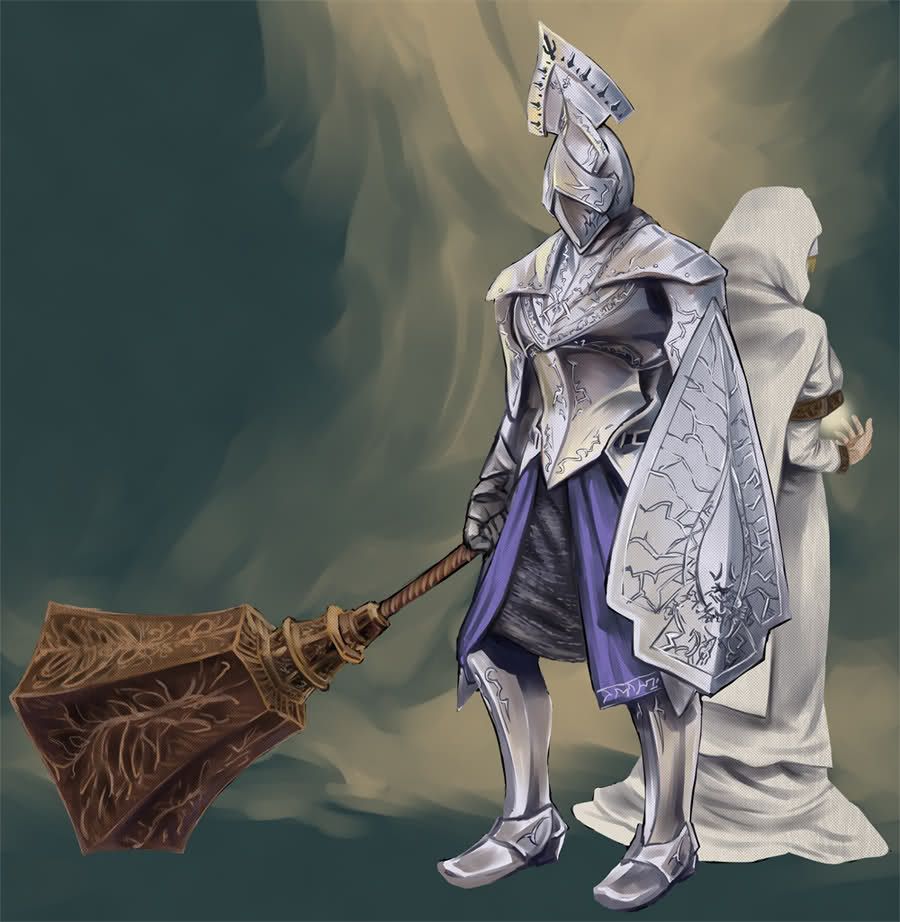

I’m a sucker for straight-up duels, and none embody that sense more so than the Maiden Astraea fight. While this fair lady is the true boss of the zone, it is her loyal bodyguard Garl Vinland that serves as the primary foe. There are several ways with which to finish this encounter (such as sniping Astraea from afar without ever fighting Garl), but doing so would deprive you of a truly memorable, albeit a bit simple, fight. Garl is all brawn, and when you meet him in the narrow corridor leading to Astraea, he stands absolutely still – resolute. His shield is raised and his gargantuan hammer, the Bramd, lifted over his shoulder. He is waiting for you to make the first move, but don’t let his weighty appearance fool you; he is more than capable of parrying your blows and delivering his own form of swift vengeance.

8. Black Dragon Kalameet
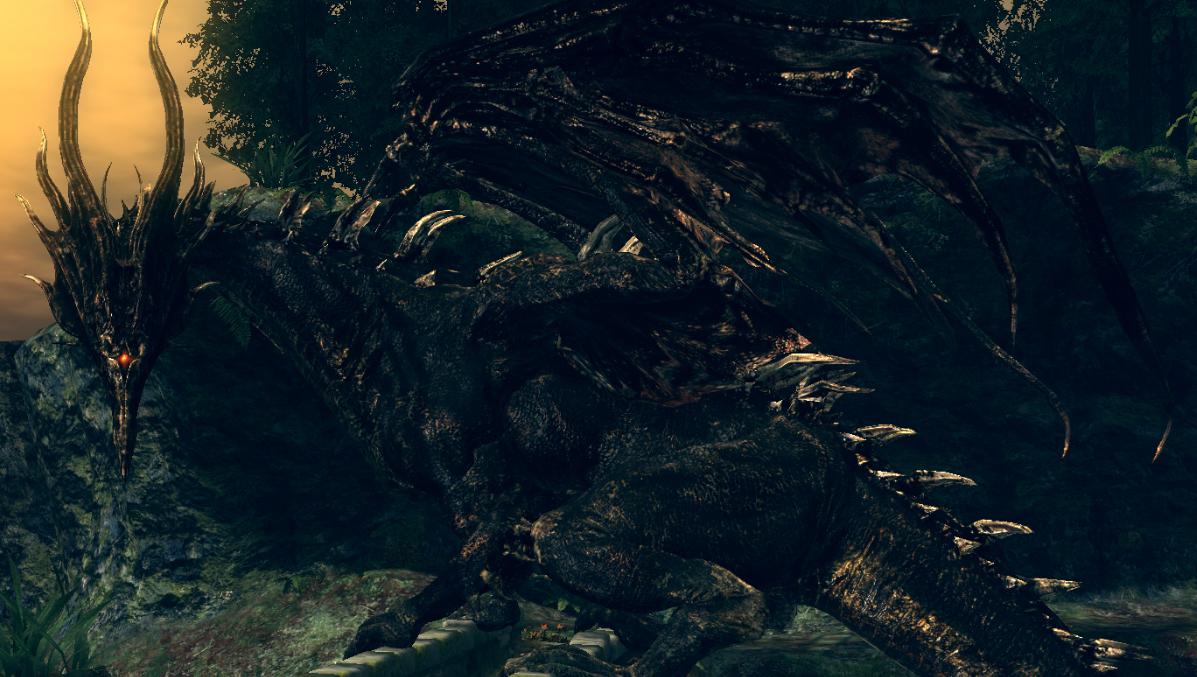

When I heard the announcement for Dark Souls, among the many things I wished for, one was at the top of the list: a true, proper dragon fight. Gaping Dragon and Seath the Scaleless seemed to fulfill that desire, but something was still missing: they were dragons, sure, but they had gimmicks. They didn’t behave like what I was expecting. What I wanted was something more along the lines of Rathalos from the Monster Hunter series. It wasn’t until the Artorias of the Abyss DLC released in 2012 (one year after the game’s initial release, first as a complete edition for PC and then as a separate download for consoles) that my desire for a real dragon fight was satiated. Kalameet was everything and more, but not only was his fight exactly what I had wanted for so long, it was also introduced in one of the most spectacular ways imaginable. With the aid of Hawkeye Gough, from his perch on high, the legendary sniper shot down the ancient dragon, allowing you to fight him at his roost.

7. Sif, the Great Grey Wolf


Wolves have a place in fantasy settings. They are often seen as companions, or otherwise symbolize justice and honor. A giant wolf with a sword in its mouth symbolizes duty, and is just plain awesome. Sif was Artorias’ loyal partner, his greatest friend. When the great knight succumbed to the Abyss, he sacrificed the last bit of his powers to save his oldest friend. Traditionally, the players meet Sif as a boss in the Darkroot Gardens, protecting the gravestone of Artorias, and, more importantly, the ring necessary to traverse the Abyss that overwhelmed his master. But in the DLC, players can find a much younger, docile Sif, protected by the spell cast by Artorias. Saving him treats you to an unusually heartwarming cutscene at the start of his fight, should you progress through the game in that order.

6. Manus, Father of the Abyss


 Manus, Father of the Abyss, possibly the furtive pygmy, the progenitor of mankind, is the last and final non-optional boss of the Artorias DLC. He brings with him an arsenal only the most prepared demon slayers can cope with. Despite his rather large size and unseemly physiological structure, Manus is swift and agile. He has tremendous reach, both physically and later with his array of dark magic spells. Not only is he perhaps one of the toughest bosses in both Dark Souls and Demon’s Souls, but it is from of him that much of the Dark Souls lore stems. The Abyss, which spread out from Oolacile and soon enraptured much of the world, was his doing, and the state of decay left in his wake is a bleak reminder of the folly of man’s ignorance and naivety.

5. Old King Allant


The true final boss of Demon’s Souls, King Allant is most notorious for one particular move: Soulsucker.  This is a unique variant of the player-learned ability in that it will actually steal a level from you if you’re hit by it. Allant’s speed is also his greatest strength, as he can cross the length of the room in mere seconds with his dashing attack. Although not particularly difficult, Allant is a formidable foe simply because of the risks that go along with fighting him. He is capable of dealing a tremendous amount of damage in a short amount of time, and with few of his abilities, can very easily one-shot you. He is also perhaps one of the best visually designed bosses in either game. He’s simple and elegant, but maintains an aura about him of otherworldly prowess.

4. The Four Kings


Infamous for their brutal aggression and the lack of spatial awareness where you fight them, The Four Kings are one of the most difficult bosses in all of Dark Souls. Initially a one-on-one fight, replicas of the King start to appear the longer the battle goes on, up to, as the name implies, a maximum of one-versus-four. Players adept enough can quickly fell one of the kings before a second appears, but with a severe hindrance to depth perception (because you literally fight them in a void of darkness) it can be very difficult to gauge the distance between you and them, resulting in either you missing many attacks, or you improperly dodging theirs.

3. Knight Artorias


The man the legends spoke of and one of the most influential figures in the history of Dark Souls lore. Throughout the game proper, you hear talk of the legendary Knight Artorias, the Abysswalker. Tales of his triumph and heroism are whispered throughout the realms. But the fabric of his legacy is a lie, a fraud perpetuated by time to hide the truth. Artorias was swallowed by the Abyss. He failed in his mission to stop the spread of darkness, and as a result, became maddened with rage. The Abyss consumed him, seeped into his body and mind and turned the greatest warrior into a fractured pawn. But he was one hell of a fight. When you meet him in the DLC, it is a humbling experience. Artorias is one of the swiftest opponents you are likely to face, with the raw physical strength to match. It’s a wonder, then, how powerful he is with only one arm (his left is broken and rests dangling at his side), that if you fought him in his prime, how difficult would he really be?

2. Flamelurker


The one and only. The boss responsible for so many deaths in Demon’s Souls, and perhaps even more ragequits. Flamelurker, or as he is more affectionately known by the community, Flamefucker, is a beast of pure aggression. From the second the fight properly begins, he is relentless. His pursuit is constant and his onslaught endless. He is arguably the most difficult encounter in the entire game on pure mechanics alone. He gets even more difficult as the fight goes on, gaining speed and damage output as the flames he is wreathed in grow larger and brighter. Sadly, he suffers from significant environmental glitches that the player can use to their advantage to easily break the fight. Despite this, in a legitimate scenario, Flamelurker remains one of the most memorable and triumphant battles in either game.

1. Dragonslayer Ornstein and Executioner Smough


Bert and Ernie. Siegfried and Roy. Siskel and Ebert. Pinky and the Brain. Pikachu and Snorlax. Whatever you want to call them (and trust me, there are many, many names), Ornstein and Smough are perhaps the greatest single boss fight in the history of the current Souls series. Developer From Software enjoys pitting the player up against odds he or she is far too outmatched to handle. One such way is to simply make him or her fight more than one enemy at a time, particularly in bosses. We first saw this in Demon’s Souls, against the Maneaters, and while those bosses did not receive a place on this list (they are certainly a notable absence), it is that concept, that sense of hopelessness that carries through into the Ornstein and Smough fight.

Visually and mechanically different, Ornstein and Smough could have been separate bosses and they each would have made phenomenal boss fights worthy of inclusion on this list. And that’s where they differ compared to every other against-the-odds encounter. Maneaters, Fool’s Idol, Bell Gargoyles, even the Four Kings featured earlier on this list – they all have one thing in common. Even though you’re fighting multiple enemies at once, they all have the same or near-identical movesets. Ornstein and Smough do not. They come at you, one with lightning speed and the other with slow, dreadful power. Ornstein, the faster of the two, moves with a blinding purpose, crossing the room in a matter of seconds with his massive spear. Smough moves brutishly across the room, and is of less concern than his speedy counterpart, but get too close and he will make excellent use of his extraordinarily large mallet.

The fight would be enough if you just had to kill them both, but no, there’s more. In typical Souls fashion, there is always a catch. Kill one, and this enrages the other, who promptly leeches the lifeforce and powers of his fallen comrade. As soon as this cutscene ends, the fight begins anew, with the living opponent’s health completely restored and his moveset now a mixture of the two. Whichever of the two is the one you kill second, that is the soul you are granted, and with it you can forge their weapon, making this a fight you have to think of not only in terms of “what weapon do I want,” but also “which one can kick my ass easier,” because that will determine which one you kill first.

Friday, November 15, 2013

The Collection Conundrum


Are remastered editions and specially-priced classic game bundles necessary in an age when there’s already such little innovation?


Everyone knows of them, and most of us have even given in to the temptation every now and then. You can’t beat a good deal, after all. With the recent surge of remastered games cropping, is there really a demand for the classics, or is it just one more nail in the coffin on a stagnating medium? There seems to be a universal outcry for innovation and new intellectual properties, and yet when a developer takes a chance on something new, it’s often met with an underwhelming response. The industry feels safe with franchises like Call of Duty, Madden, and Final Fantasy because they continue to sell. Brands sell, not ideas. And it’s because of this that the developers are now starting to give more attention to the classics that made them famous in the first place.

Collections are nothing new. Back in the PlayStation era, then-Squaresoft was putting out bundles like Final Fantasy Chronicles, Anthologies, and Origins (although Chronicles was produced after the Square/Enix merger) which contained enhanced ports of their earlier games. Prior to this, Nintendo had Super Mario All-Stars, a single-cartridge collection of four Super Mario Bros. games for the SNES. All of these went on to relative success and opened the role-playing and platforming doors to newcomers. But they were scarce and timely. You didn’t see a new collection every month, perhaps because the gaming library was not as diverse as it is today or perhaps because there just wasn’t a market for it yet. Whatever the reason, both of those are precisely why the whole Collection Revolution is going strong today.

Go to your local GameStop or Best Buy and I guarantee you’ll find a handful of game bundles of either older or current generation games (or both): Resistance, God of War, Metal Gear Solid, Uncharted. Collections like these and more are becoming more frequent in an age when stagnation and mediocrity is all too prevalent. With your yearly iterations of franchises like Call of Duty, Madden, and Assassin’s Creed, the trend seems to hinge more on the philosophy of “stick to what works.” Because hey, if it ain’t broke…right? But that’s the problem – it is broke. The system is crippled, and something needs to be done.

It seems like every time there’s a new innovation in the gaming market, it’s often looked at with disinterest or caution. And that’s fair: it’s natural to be skeptical of something you’re unfamiliar with. But skepticism and disregard shouldn’t go hand-in-hand. Just because you’re unsure of something doesn’t mean you should completely ignore it and maintain a play style that’s comfortable to you. With services like GameFly, you have the option to rent games and try them out before spending a sizeable portion of money on them.

Below is a (short) list of some of the more popular HD Remixes/Collections that came out between 2012 and 2013.

Jak & Daxter Collecttion – February 7, 2012
Silent Hill HD Collection – March 20, 2012D
Devil May Cry HD Collection – April 3, 2012
Ratchet & Clank HD Collection – April 28, 2012
Tony Hawk’s Pro Skater HD – August 28, 2012
God of War Saga – August 28, 2012
inFamous Collection – August 28, 2012
Killzone Trilogy – October 23, 2012
Zone of the Enders HD Collection – October 30, 2012
Assassin’s Creed Ezio Trilogy – November 12, 2012
Mass Effect Trilogy – December 4, 2012
Resistance Collection – December 5, 2012
Hitman HD Trilogy – January 29, 2013
Metal Gear Solid: The Legacy Collection – July 9, 2013
Kingdom Hearts HD 1.5 Remix – September 10, 2013

Are some of these collections worth it? They can be. Quite frankly, worth and value is something that each person defines individually. As a console’s life cycle nears its end, as we’re witnessing now with the PlayStation 3 and Xbox 360, and the new wave of technology comes forth, we’re finding that backwards compatibility is soon becoming a thing of the past. Developers are more inclined to charge consumers again for products they may have already purchased, and still own, rather than allow them to simply play their old copy. Of course, then there are those people who may have never shown an interest in some of those earlier games, and are now suddenly finding themselves in the mood for a new experience. That is when complete collections like the God of War Saga are at their most influential.

But when you have something like the Kingdom Hearts HD 1.5 Remix, which only contains 3 of the 7 games in the series, you know you’re dealing with a company willing to nickel and dime its consumers for all they can get. There’s a line in the sand when it comes to these sorts of things, and when we start to cross it by buying into every single re-release that comes out based on some feeling of nostalgia or necessity, then we give those developers every right to resist change and progress. We tell them with our wallets that “We don’t want you to make new games. Keep giving us old products.” We may as well just rebuy the same game every year, if that’s the case. Call of Duty fans already do, and look how successful that franchise is.

Wednesday, November 13, 2013

Vanquish Spotlight Review


Created by renowned action-adventure developer Platinum Games (formerly Clover Studios of Okami, Viewtiful Joe, and God Hand fame), Vanquish was part of Platinum's agreement with Sega to develop a set of four games under them, the other three being MadWorld for the Nintendo Wii, Infinite Space for the Nintendo DS, and Bayonetta for the Xbox 360 and PlayStation 3. Vanquish, for whatever reason, failed to achieve the same kind of success as Bayonetta, despite the universal praise for its unrelenting sense of speed and brilliant gunplay. Perhaps it was the game's short campaign, its steep learning curve, or even its reliance on speed that led to its minimal sales, but in the eyes of critics and fans alike who experienced it, it was labeled the new standard for third-person shooters.


The Short Version

Why You Should Play This Game: High-octane action; frenetic third-person shooting; rocket-powered knee sliding; shoot-em-up style bosses with projectiles galore
What You Can Play It On: Xbox 360, PlayStation 3
Published by: Sega
Developed by: Platinum Games
Released: October 9, 2010

The Long Version

The Russians are at it again. In the near future when Earth’s population has reached critical mass, humanity engages in a global scavenger hunt for any and all available resources. Unable to maintain the chaos for too long, the United States of America assembles and launches the O’Neill Cylinder space station, a habitable vessel harboring a solar generator to harness the energy from the sun and provide sustainable fuel. In a coup d'état by a Russian nationalist force known as the Order of the Russian Star, the former Soviet Union’s government is overthrown and its military realigned. The Order attacks and overwhelms the defenseless crew of the space station, and using their newly-acquired solar energy from the generator, they transfer it into a blast wave that strikes the heart of San Francisco. With New York as the next target, the Order’s leader, Victor Zaitsev, demands that the American government offer their immediate surrender.

Vanquish is a title not to be lauded for its complex characters, emotionally riveting tale, or philosophical themes simply because there are none. At its core, this is a shallow, rudimentary, and unsophisticated romp through an orbital space station that will sooner have you cursing at the heavens than pondering its existence. But it’s in the style and presentation that manages to make this such a remarkably entertaining adventure that’s quite aware how utterly outrageous its plot is and how absurdly stereotypical the lead characters are. Goofy dialogue that would otherwise sound like complete rubbish doesn’t rub off in such a grating way as it might in nearly any other game. The story is completely expendable, offering little in the way of provocative discussion, and the characters are flatter than Paper Mario, but the whole package is in excess of pure, raw, testosterone-injected manliness. And that’s fine by me.

On the surface, Vanquish appears unremarkable. A sci-fi third-person shooter about a Russian uprising starring Solid Snake in space. (Well, Solid Snake anywhere is in and of itself interesting enough). To be quite honest, without the few things that make Vanquish truly shine, this review might have headed in a completely different direction. But thankfully, the platinum-minds over at Platinum Games, and the master himself Shinji Mikami, know how to make a stale and over-saturated genre feel as fresh and new as a baby’s bottom in spring time. Vanquish’s concept can boil down to a single word: speed. Everything is about speed, either the increase of speed or the deceleration of it. Though the game features a cover system and regenerating health, these are not the saving graces you’ve come to expect from other games of this type. Most cover deteriorates under persistent fire, while other cover may actually be a robotic enemy in disguise. This, as well as refreshingly intelligent enemies that tend to flank and overwhelm you if you remain in a single location for too long, or otherwise throw grenades your way, add a great sense of urgency to an already frantic game.


The DARPA (Defense Advanced Research Projects Agency) Suit is, in essence, your primary weapon. As Sam Gideon, the title’s gruff and reckless protagonist who has a penchant for lighting up a cigarette in the midst of a heated battle, you will use the suit as both an evasive gadget and a defensive shield. Well-equipped with speed boosters, the suit can propel Sam at blinding speeds as he rockets by enemies on his knees to and fro. Similarly, the suit controls Sam’s other time-manipulation, allowing him to slow down the world around him to a near-stop. Both abilities drain the suit of its energy, which quickly regenerates when not in consumption. However, abuse either mechanic too much and the suit will overheat, preventing the use of each one for a short amount of time. This forces an interesting dynamic between taking cover or popping out and boosting around the environment. Don’t rely on either one entirely; instead, strike a balance and learn where certain cover walls are. That way you can speed boost between one and the next and never leave yourself out in the open for too long. The suit has a fail-safe mechanism of sorts. If you take enough damage in a short amount of time, it will automatically trigger a slow-down mode allowing you some time to react and get into hiding before you’re shot dead. This is a double-edged sword, however, because while it can save your life on many occasions, it will also overheat the suit, preventing you from using either of the abilities for a short amount of time. This makes an already hectic system even more dependent on caution and care.

Combat itself is just as frenetic. At any time you’ll have gunfire and missiles raining down on you from any given direction. Your own means of offense is itself just as unique as the DARPA suit. An experimental weapon, the BLADE system is a single unit that allows Sam to scan any type of weapon in the game and immediately materialize into it. Capable of holding up to three guns of any type, the player can choose from nearly a dozen different types of firearms with which to bring into combat against the Russian cybernetic army. In many cases, you’ll find yourself switching weapons in and out depending on the current situation; maybe you need a sniper rifle to pick off those pesky sharpshooters in the distance, or maybe you’ll want to pick up that rocket launcher and make short work of the much larger foes. The battlefield is usually plentifully littered with various guns to keep yourself ship-shape, but in the thick of combat, it’s not unlikely to find yourself running low on ammunition and with your suit overheated.

Weapons can be upgraded in either one of two ways. If one of your currently equipped weapons, say the Assault Rifle, is maxed out on ammo, and you go pick up an Assault Rifle that you find in a weapon chest or dropped by an enemy, rather than do nothing, this will add a single line to the weapon’s icon in the bottom-right of the screen. Do this three times and the weapon will be upgraded in rank, raising ammo capacity and either its damage potential, firing rate, reload speed, or what have you. If you happen to pick up a weapon which you already possess, but have expended some of its ammo, then it will simply refill the ammo. On the other hand, you can also find instant upgrade kits which will not only upgrade the weapon you currently have equipped a single rank, but it will also refill its ammo completely. As such, don’t expect to find too many of them throughout a single campaign. To add some consequence, if you play on any difficulty setting above the Casual modes, frequent deaths will start to diminish the quality of your upgraded weapons. This might create some interesting situations when deciding what guns to upgrade in fear of losing those upgrades minutes later.


But I’ve yet to talk about the best feature in the game: lighting up a cigarette in the middle of combat. More than just a superficial mechanic, this actually has a fairly tactical use. When behind cover, you can have Sam light up and take a quick hit before flicking the cigarette butt out into the open. Yes, this looks incredibly cool when there’s a hail of gunfire whizzing passed you in every direction. But more than that, the cigarette butt acts as a distraction for enemies. For that brief moment when it’s in the air, enemies will instinctively shoot at it, taking their attention away from where Sam was. This allows you a tiny but indispensable moment of time to pop out of cover, preferably with time slowed down, and pick off one or two of the enemies, or potentially more. The cigarettes are in short supply, but they are replenished on a regular basis. Like everything else in the game, though, don’t rely on them too much. Abuse it often and you may find yourself without their aid at a time when you desperately need it.

Vanquish looks stunning. Everything from the environments and level design, the appropriately exaggerated character models, and most impressively the DARPA suit itself. Sam’s suit was crafted with such immaculate attention to detail that every little bit of it looks jaw-dropping. All of the bells and whistles attached to it emphasize how much care was put into making the game look and feel unique despite its redundant and admittedly nonsensical plot. Dialogue is purposefully B-movie grade to compliment the hum-drum story, but every now and then Sam or his wing-man Lieutenant-Colonel Robert Burns will spit out a clever line. The voice acting is good enough, particularly on the part of Sam, voiced by Gideon Emery (notable for his roles as Balthier from Final Fantasy XII and the voice of John Connor from the Terminator Salvation video game). Don’t expect to recognize him immediately, because his gravely and grizzled voice is intentionally overly-macho to again reflect the hyperbole of these characters. If you want to really mess with your head, compare Sam’s voice to that of Balthier’s and see the difference for yourself.


Musically, the game seems to be hit or miss. For the most part you might not even notice that a track is playing, particularly in the heat of combat when the sounds of battle are drowning everything else out. This can be a good thing, however. Vanquish is a game that requires tremendous concentration and focus. Having music play over your utter demise can grow to become a frustrating and annoying experience in a game that thrives off of a player‘s tears. When you do notice the music, it works, and it’s a fitting ensemble of typical action flare.

Vanquish is not a hard game to recommend, but it is assuredly a hard game to play. If you’ve become accustomed to the standards of most modern shooters, particularly those that emulate the Gears of War formula, then Vanquish may prove itself a formidable foe. It is a beast unto itself, unlike anything else on the market. The campaign is short, clocking it at roughly five to ten hours, potentially less if you play on more modest difficulty settings. But it is a game that harkens back to the arcade era, where you’d play and then replay over and over and over again trying to get a higher score. And for that there is no shame in its shortened campaign, because anything longer would have felt extremely tacked on and may have only hindered the experience. This is a game that connects you directly to a source which injects pure, unfiltered adrenaline into your veins. If you’re looking for a game to shock your senses, Vanquish is the only answer.

Tuesday, November 12, 2013

Gaming Crossword Puzzle

Think you know games? Test your trivial knowledge with this custom-made crossword puzzle.

Across
5. The unsung hero of the Lion War
8. A term coined by the space pirates and originally referred to as the “Great Poison” by the ancient civilization
11. The real name of this sun-goddess-turned white wolf artist
12. A fungus that has mutated and caused the near-extinction of the human race
13. The anthropomorphic pink mascot created by HAL Laboratory
17. The lethal drug indirectly responsible for the death of this former New York City detective-turned-vigilante's family
19. This game series is loosely inspired by a Chinese novel featuring the mystic crystals known as the "108 Stars of Destiny"

Down
1. The screw-propelled mobile ballistic system developed parallel to a series of bipedal nuclear tanks
2. A highly advanced machine race previously thought to be extinct
3. A notorious boss known for his distinctive flames and his relentless pursuit of demon slayers
4. A submerged tribute to Industrial America, this sunken city borrows heavily from the themes found in several Ayn Rand books
6. This world's name is characterized by the cycle of life and death, a prominent theme in its featured game
7. A highly evolved soldier stripped of his wings and tossed into the Abyss by his clan leader
9. SquareEnix will tell you they're not TaruTarus, but they most certainly are
10. Renowned developer known for his habit of making excessive promises but failing to meet them adequately
14. A guide to the player in voice only, this man spent nearly his entire life trapped in the forsaken mines of remote Greenland
15. Its name, according to one of the main characters, means "big fire"
16. A seemingly immortal artificial soldier who could regenerate his own limbs, his name is derived from the Latin for “whiteness”
17. Son of a demon and human, he has a twin brother who has been known to run his mouth
18. What can change the nature of a man?